Aparajitha Raja and the Possibility of Transition from Activism to Mainstream Politics
India’s political mainstream has consistently drawn leadership from spaces where public engagement begins early—universities, student organisations, and youth movements. These arenas have historically served as testing grounds where ideological clarity, organisational discipline, and public responsibility are shaped well before entry into formal electoral politics. The public trajectory of Aparajitha Raja reflects this tradition and invites attention to the possibility of her emergence as a future figure in mainstream politics.
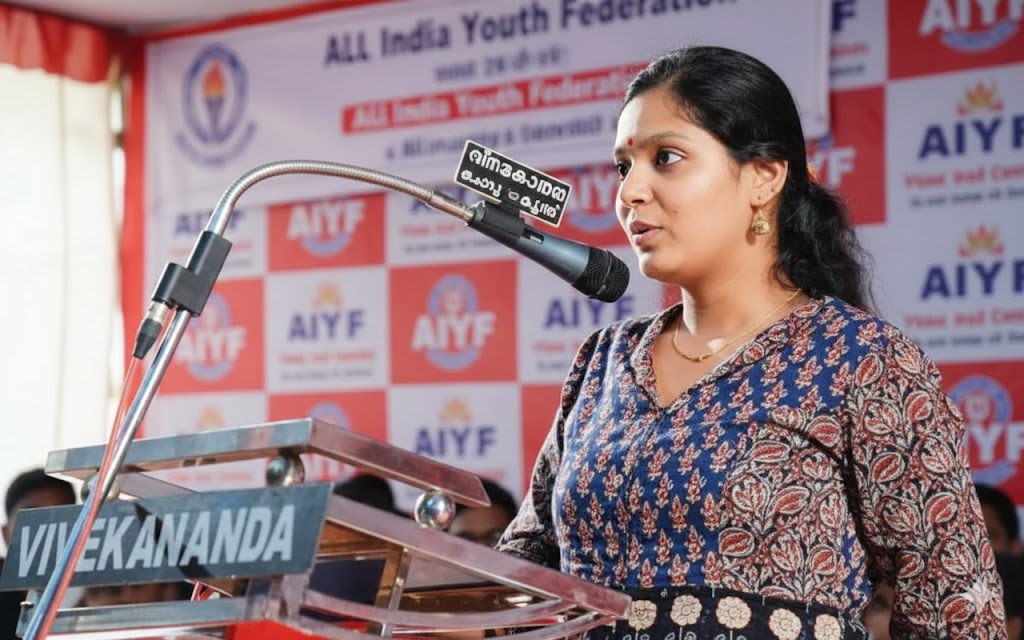
Aparajitha Raja has been active at the national level within structured organisations, serving as a former national leader of the All India Students’ Federation (AISF) and as a national council member of the All India Youth Federation (AIYF). Through these roles, she has been involved in student and youth mobilisation across regions, engaging with issues that extend beyond individual campuses to broader social and democratic concerns. Her public work has largely centred on questions of education, equity, representation, and social justice—areas that often form the ideological foundation for long-term political engagement.
An important contextual factor in assessing her leadership trajectory is her family background. Aparajitha Raja is the daughter of D. Raja, the General Secretary of the Communist Party of India (CPI), and Annie Raja, the General Secretary of the National Federation of Indian Women (NFIW). This background places her within a family environment deeply engaged with parliamentary politics, mass organisations, and social movements. In Indian public life, such political lineage often provides early exposure to ideological debate, organisational functioning, and democratic processes, while also setting higher expectations for independence and credibility.
What is notable in Aparajitha Raja’s case is that her public visibility has been built primarily through her own organisational roles rather than formal political office or inherited position. Leadership within AISF required coordination across states, interaction with diverse student communities, and participation in national-level discussions. These responsibilities demand skills that are directly relevant to mainstream politics—articulation of collective concerns, negotiation across differences, and sustained organisational commitment.
Her transition into AIYF represents a widening of focus from student-specific issues to broader youth concerns. Youth organisations occupy a critical space between activism and formal politics, often shaping narratives that later enter legislative and electoral discourse. Engagement at this level introduces leaders to questions of employment, gender justice, social inclusion, and democratic rights—issues that resonate across constituencies and are central to electoral politics.
The possibility of moving from activism to mainstream politics is influenced by multiple factors: organisational continuity, public trust, ideological consistency, and the ability to connect with a wider electorate beyond activist circles. Aparajitha Raja’s experience suggests familiarity with these dimensions. Her public interventions have tended to situate individual issues within broader social frameworks, a perspective that aligns with the demands of parliamentary and mass politics, where long-term vision and policy coherence are essential.
Family background, in this context, functions as an enabling but not determinative factor. It provides political socialisation—an understanding of how institutions operate, how movements interact with the state, and how leadership is sustained over time. Combined with independent activism, such exposure can strengthen preparedness for mainstream roles. At the same time, it places responsibility on the individual to demonstrate autonomy and public relevance beyond lineage.
Women’s leadership is another important dimension of this trajectory. The movement from student and youth activism into mainstream politics has historically been more challenging for women due to structural barriers and representation gaps. Visibility and leadership at the national level within student and youth organisations contribute to normalising women’s presence in political spaces that require negotiation, resilience, and public engagement. Aparajitha Raja’s roles reflect this gradual expansion of leadership pathways.
Contemporary politics also presents distinct challenges. Leaders emerging today must operate under constant public scrutiny, rapid media cycles, and ideological polarisation. Activist backgrounds can offer clarity of purpose, but successful transition to mainstream politics often requires adaptation—balancing conviction with inclusivity and negotiation. Experience within mass organisations can play a critical role in this adjustment.
From a broader democratic perspective, Aparajitha Raja’s journey illustrates how India’s political mainstream continues to be shaped by sustained civic engagement. Student and youth organisations remain important intermediaries, allowing leadership to mature through experience rather than immediate electoral entry. Such pathways contribute to political renewal by introducing leaders who are grounded in organisational work and public advocacy.
Whether Aparajitha Raja chooses to enter electoral politics in the future remains open. What is evident is the convergence of factors that historically precede such transitions: national-level organisational leadership, sustained engagement with social issues, and political socialisation within a public, mass-oriented environment. These elements do not guarantee entry into mainstream politics, but they do make such a transition plausible and credible.
In examining figures like Aparajitha Raja, the focus need not rest on prediction, but on preparedness. Mainstream politics requires the ability to translate ideas into policy, represent diverse constituencies, and operate within institutional frameworks. Experiences gained through student and youth leadership contribute meaningfully to this preparation. In that sense, her trajectory represents one of the pathways through which India’s political future continues to take shape—rooted in activism, informed by organisation, and open to the possibilities of public life.